


The Skin Problem: Why We Built a Phantom System for Electrode Testing

When you're developing wearable bioelectronics—particularly systems that read electrical signals from the body—one uncomfortable truth emerges quickly: real skin is a nightmare to work with.
The Real Skin Problem
Try optimizing electrodes for electromyography (EMG), electrocardiography (ECG), or any skin electrophysiology application, and you come accross the same frustrating story. A measurement that works perfectly on one person fails on another. An electrode design that performs well on the forearm produces noise on the arm. Run the same test on a humid day versus a dry one, and your impedance values swing wildly. This isn't sloppy science—it's the inherent reality of biological interfaces.
The Sources of Variability
The problem stems from multiple compounding factors:
Inter-individual differences: Skin is highly variable. Factors like hydration level, sebum production, skin thickness, and subcutaneous fat vary dramatically between people. Someone with dry skin and someone with oily skin present fundamentally different electrical properties to an electrode. Age, genetics, and even ethnicity influence skin conductivity. What works as an "optimal" electrode design for a 25-year-old software engineer may perform poorly on a 60-year-old with different skin characteristics.
Anatomical variability: Different body regions have wildly different electrical properties. The forearm has different thickness, hair density, and sweat gland distribution than the calf or chest. The back of the hand has thin, hairless skin; the bicep is thicker and often hairy. These differences create different impedance profiles that can't be easily predicted.
Environmental sensitivity: Skin impedance is exquisitely sensitive to moisture. A measurement taken in an air-conditioned lab differs from one taken after exercise, or in a humid environment. Temperature, ambient humidity, and even the time of day affect the skin's electrical properties. For reproducible research, this variability becomes a major barrier.
Temporal drift: Even on the same person, in the same location, measurements drift over time. Skin adapts to the electrode, hydration changes, and sweating introduces variability. Running a 20-electrode comparative study becomes a statistical nightmare—you can never be sure if differences are due to electrode design or noise from skin variability.
For researchers trying to optimize electrode geometries, materials, or contact properties, this creates a vicious cycle: you need real skin to validate designs, but real skin's variability makes validation nearly impossible.
The Standard Workaround (and Why It Fails)
Historically, researchers have dealt with this by averaging across many subjects, running studies with large cohorts, and hoping that statistical power compensates for biological noise. It works—sort of. But it's slow, expensive, and masks the signal you're trying to find.
Some groups have turned to simplified models: conductive gels, saline solutions, or basic resistive networks. These are reproducible, but they're also completely unrealistic. A saline solution doesn't capture the layered impedance of actual skin, the frequency-dependent behavior, or the complex dielectric properties that make skin such a challenging interface.
You gain reproducibility but lose biological relevance.
Our Approach: Engineering Skin
After years of collecting electrode-skin impedance data across different populations, body sites, and conditions, we realized we had something valuable: a comprehensive dataset of what real skin actually looks like electrically. The insight was simple: we could engineer a phantom system that faithfully reproduces the electrical complexity of human skin.
The Two-Layer Phantom System
Our phantom consists of two layers, carefully tuned to replicate the frequency-dependent impedance of real human skin:
Layer 1 (Epidermis): A thin, higher-impedance layer that mimics the outer skin barrier. This layer captures the resistive properties of the dead outer skin cells and the capacitive effects of the stratum corneum.
Layer 2 (Dermis/Subcutaneous): A thicker, lower-impedance layer that represents the living skin and underlying tissue. This layer is tuned to match the conductivity and permittivity of deeper tissue.
By carefully selecting material compositions and thicknesses—drawing from our empirical electrode-skin impedance measurements—we created a system that reproduces the complex impedance spectrum of real skin across the frequency range relevant to EMG (typically 100 Hz).
What Makes This Powerful
Our system captures the frequency-dependent behavior of skin. Impedance changes with frequency, and this matters. Electrode designs that look good at DC can perform poorly at the actual measurement frequencies used in EMG systems. Our phantom reproduces this real-world behavior.
More importantly, the phantom is completely reproducible. Run the same electrode on the phantom 100 times, and you get essentially identical results. No variability from hydration, sweat, or individual physiology. This means:
Comparative analysis becomes tractable. Want to test 20 electrode geometries? Previously, you'd need to test each on multiple people to account for skin variability, compounding uncertainty. Now, you can run all 20 on the phantom, get clean comparative data, and then validate your top candidates on real skin with full confidence that differences are due to electrode design, not noise.
Design iteration accelerates. Optimize your electrode in the phantom, measure the results precisely, refine, measure again. The tight feedback loop makes it possible to systematically improve designs in a way that human testing never allows.
Understanding the Figure
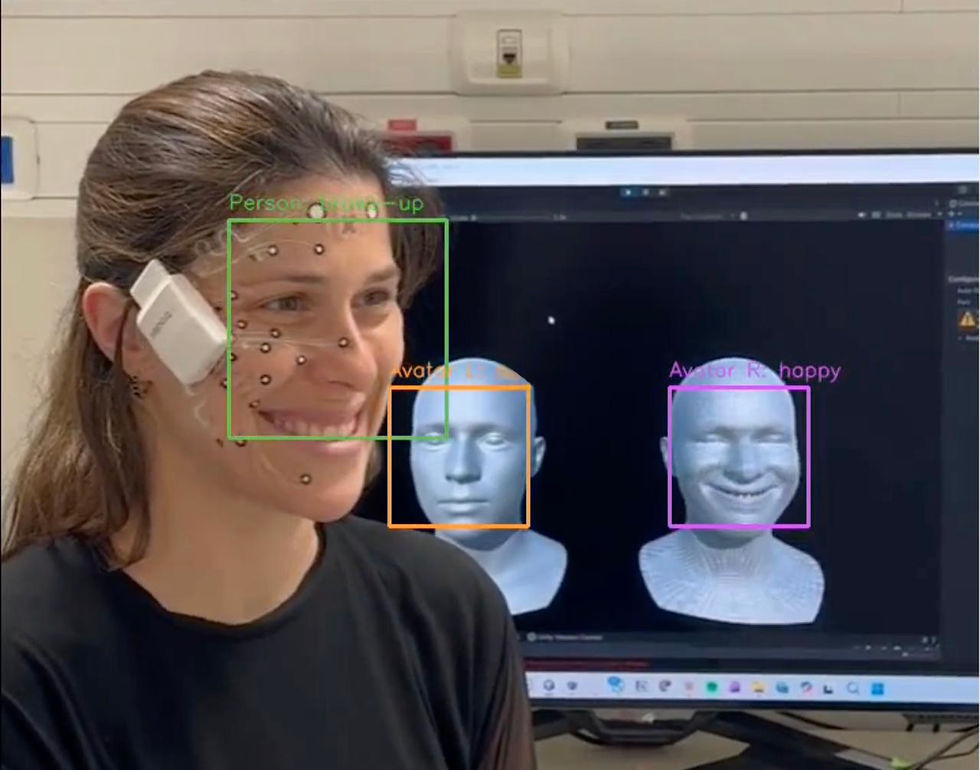
The image shows our system in action:
Left panel: The phantom system in a petri dish. The white device at the top is the data acquisition unit (by x-trodes) connected to the electrode array (by x-trodes) under test. The phantom material below it—is carefully formulated to mimic skin's electrical properties. Multiple electrode contacts are visible, arranged to allow impedance and signal measurements.
Right panel: The same electrode design worn on actual human skin. Notice the identical electrode pattern, the flexible substrate, and the connector.
Looking Forward
The phantom approach opens new possibilities. We're now exploring how to tune phantom layers for different skin types—a version that mimics dry skin, another for oily skin, one for aged skin. This lets developers understand how their designs perform across the population without needing human subjects.
We're also investigating how to capture other important aspects: hair follicles, sweat glands, and the elasticity of skin. The electrical properties are settled, but there may be mechanical and physiological factors that matter for long-term comfort and signal stability.



Comments